Friday, September 23, 2011

INTO THE AMAZON - JUST

After leaving the Pantanal we head north, and then northwest. We do lots and lots of miles. This is a huge country and we drive on lots of rolling road with 1,00's of big trucks. Most of the land is cattle farming. Eventually we arrive at Porto Vehlo and drive directly into town to camp at waypoints we have been given, to the Museo de Ferro Maderia-Mamore (the train museum on the riverfront). It is Sunday night and the place is pumping. Lovers are out wandering. We head to a large plaza to eat with the locals. John is very adventurous and has a seafood soup with loads of unknown extras, while I stick to a corncob, but lash out with a tapioca pancake with a weird combination of cheese & banana.There is a performance going on at the ampitheatre when we return. Pity we can't understand a word of Portugese, but it is something to do with a bull and village people. Later we are seranaded by local singers and even later by ghetto blasters from cars. Peace reins by midnight.
After exploring the city centre and train museo we head further north into the Amazon area. A lot of overlanders catch the balsa/ferry at Porto Vehlo to Manaus, but we decide to drive as far as we can on the Manaus road.  All the info we have says that this road is impassable.  So we follow the signs to Manaus - which take us to a balsa, and we have our first Amazon cruise. They are in the process of building a massive bridge, but it may take a while yet. The road is great - smooth & sealed. The weather is hot & humid with temps up to 40 C, so it is more pleasant sitting in the cab with the aircon on than anything else. It's a lovely drive to Humjata, which is an amazingly large place in the middle of nowhere. Pretty scruffy, with lots of boats on the huge coffe coloured river.
Then we continue on the road to Manaus - we just want to see how bad it really is. We stop for the night beside a river just before it pours with rain. It is amazing how much trffic pases in the night for a road that goes nowhere. At about 4am a truck stops & honks his horn. When he gets no responce from us he comes over & knocks on the door. We gather he wants company on the road to Manaus. YES the road is open. We pass on the oppurtunity at 4am and in the morning decide NO we have not done any research for those countries, I think of the heat and John thinks of the sticky red mud and our tyres turning to slicks. We really need to go with another motorhome.
So back to Porto Vehlo and on to Guajara-Mirian, where we plan to cross into Bolivia. We arrive at 5pm, not the best time to cross a border as it will be dark by the time we finish. I have found a Lodge upriver that might let us park in their carpark, so we head there. We finally find Pakaas Palafitas Jungle Lodge (more by good luck than my navigational skills), the owner speaks English and says sure we can overnight in their carpark, use their pool and Wifi at no cost.WOW! There are no other guests staying and the pool is amazing. It overlooks the confluguence of 2 rivers. We stay for 2 nights and spend a whole day using Wifi and lazing by the pool. Luxury. We did buy lunch there (for all of you who think we are tight.)
The owner told us about a road from Brazil to Cusco that is all sealed. Sounds good to us. Better than all those extra dirt miles in Bolivia. So again a change of plan. We head back to town - it may have been "interesting" to cross here as we see no vehicle barges crossing the river. We continue on to Rio Branco. The road is a bit of a patchwork quilt, the scenery mainly farming with some remaining forest. There are even some rubber tree plantations. Then another river crossing, before we reach the modern city of Rio Branco. There are lots of cars and 1,000s of motorbikes, so Finally we find a spot and head off to explore. There are quite a few free museos to look at. The best is the Museo da Borrancha(rubber) with great exhibits. We even get a demonstration on cutting & collecting rubber on the tree outside.
In this area there are a lot of motorbike takis. The drivers wears a bright vest and carries a spare helmut for his passenger. There are heaps of these "taxis" nipping everywhere. Another thing we see a lot of are "lanchonettes" (cafes) that have pool tables. Very, very popular.
Our final detour before we leave Brasil is to the small town of Xapturi to see the home of Chico Mendes. He has hero status here with his efforts to preserve the rainforest. We also wanted to tour the Fabrica de Preservativos (condom factory- using the local rubber), but it wasn't to be. You had to ring ahead to book! Very differcult when you don't speak any Portugese.
The border crossing is pretty simple. We just have to wait for them to open from their 2hr lunch. We leave the Peru border with a new Sunat sticker on our windscreen (this one much easier to get than the one at the port of Lima)
Now we are in the Peruvian Amazon. Hot, humid and much more forrested than Brasil. The trucks are carrying massive logs. The villages consist of simple wooden thatched huts, but hey, the road is fantastic. Much better than the road in Brasil. We are travelling the Carretera de Pacifico.
Camping beside the river there are lots of bitey little midgees, and in the morning we see footprints of a rather large cat.
Before reaching the first large town there are huge areas of squatters on both sides of the road. They look like what you imagine gold rush shanty towms looked like. It would be fascinating to find out why these have been set up here.
Puerto Maldonado is the only town in this Amazon area. Here there is a massive brand new bridge across the huge river. There are lots of Amazon Lodges up & down the river (only accessible by boat). The town is frantically busy with the usual markets, and 100's of motorbikes & mototaxis. After leaving town we see lots more shanty towns before gradually heading up into the mountains. We leave the Amazon and the heat behind us.
Adios
Sorry guys, for some reason this old post was still sitting in my draft box....so you will get it very late

Wednesday, September 14, 2011

WILDLIFE SPOTTING IN THE PANTANAL - PHOTOS

Huge blue & yellow Macaw - Southern Pantanal

Scarlett Macaw - at Bonito Pool

My favorite - the Toucan - at Bonito Pool

AGiant Otter in the Pantanal
Itapiu Dam - second largest in the world

Lots of squatters on the side of the road - we have seen lots here in Brasil. Naybe they are itinerant workers looking for cheap accomdation because we have seen cars parked at them too

Lovely little town of Bonito- with a local Toucan

Our tour guide inside the grotto

Fish at the Municpal Pools - you can swim with them...and they are seriously big

Caimans, caimans, caimans

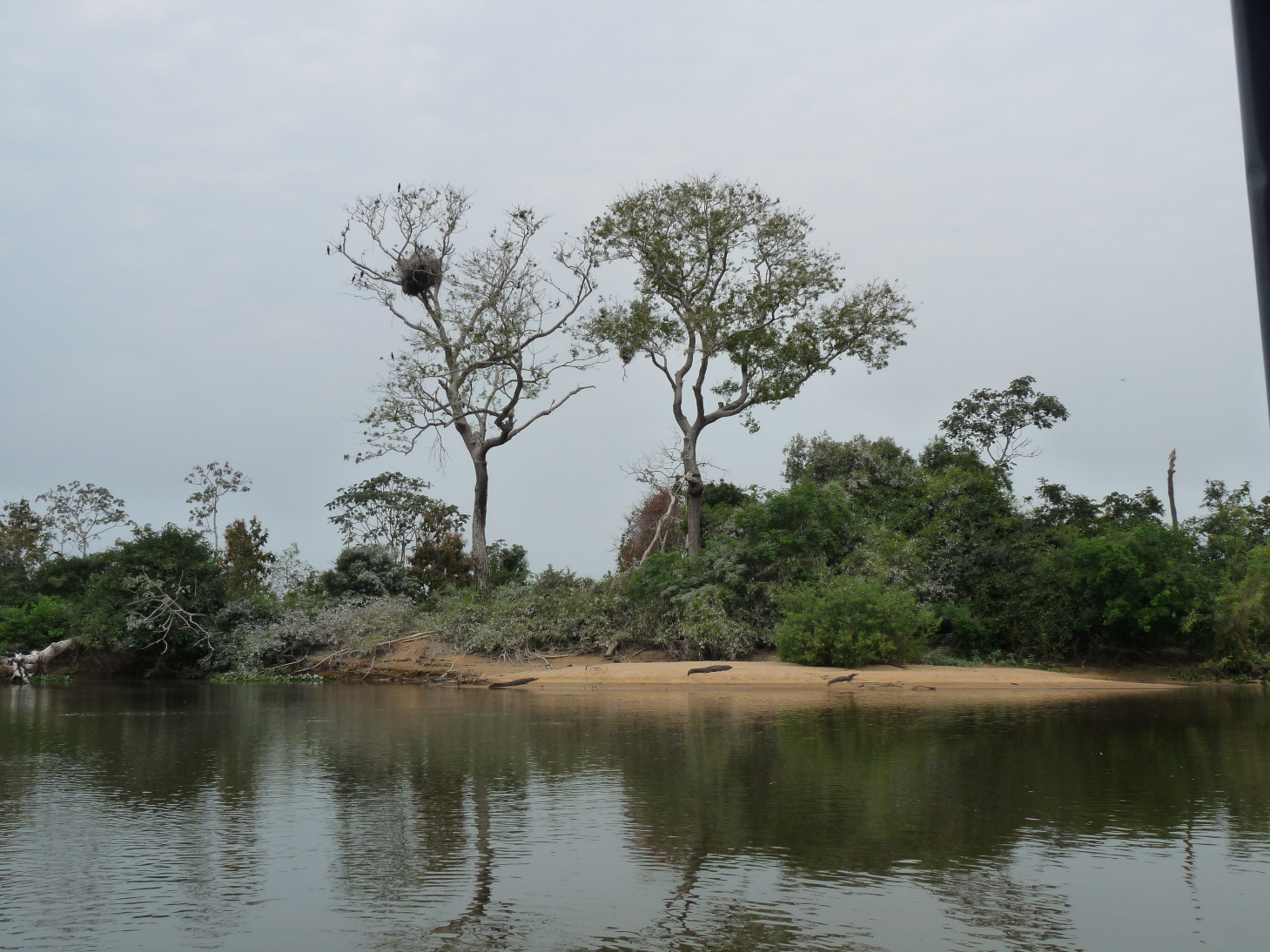
Boat trip on the river

Huge nest

One of the wooden bridges (Southern Pantanal)

A howler monkey

Another bird - forgot his name

Even more birds

Capybara and her babies

See all those eyes glowing at night - our camp site

Our camp spot with the locals

One of those 125 rickety wooden bridges

Gorgeous waterways

Massive lily pads at Porto Jofre

We met this guy on the road - he hissed at us

WILDLIFE SPOTTING IN THE PANTANAL

Our next destination is the state of Mato Grosso and Mato Grosso do Sol, and more specifically The Pantanal. But first we take a side trip to Itaipu Dam jointly owned by Brasil and Paraguay. It is the second biggest dam in the world, and so is absolutely colassal. Sadly they no longer run free trips as mentioned in the Lonely Planet, but we still paid about $10 each for a your in a double decker open top bus. It was pretty awesome, and our photos don't show it's immense size.
Then we had to get lots of miles under our belts to get to our destination, passing lots of sugar cane growing and  huge ethanol plants. Many of the cars & motorbikes here run on ethanol made from the sugar cane.
Our first stop is the pretty, touristy town of Bonito, where we hunt for an agency to book a few tours. We find the very helpful Naurio Jorge og Angencia Brazil Nature (www.agenciaabn.com.br) who speaks fluent English, and he organises our tours. our first one is a tour of the Gruta do Lago Azul at 7.30am the next day. As all the tours are well out of town we choose to go and camp in the carpark for the night, so that we were there bright and early (in fact we were an hour early - we had not realised that there was a time change somewhere). The trip involved a walk into a cave with an amazing azure lake. We had a schoolgirl in our group who translated for us.
Then we drove on to an Estancia to get into wetsuits for an hour snorkel along a river. We wore life vests so that we could simply float down the river (this was to stop us damaging the environment by touching the bottom) It was incredibly clear with loads of huge fish. After a great buffet lunch we headed back into Bonito to the Municpal pools. We were having another very hot day in the high 30's. The pool was actually a bend in the river shared by people and fish alike. There were thousands of fish swimming in the water. We had a great few hours people and bird watching. There were lots of birds. I enjoyed the tocans and John enjoyed the birds with "dental floss" bums. We couldn't camp overnight in the pool's picnic area, so we simply moved next door and camped in front of the campground for free. (John did check if it was OK with them first)
We head north to Miranda on the scenic route (read here Lynda's navigation was a bit out) - the old dirt road. This proves to be great dispite having to detour through farms and open lots of gates. Eventually we are heading to the wetlands. At one bridge we cross we stop to see 100's of caimans (crocs) sunning themselves on the banks of the river. These are just the tip of the iceberg, apparently there are estimated to be 48 million caiman in the Pantanal. We eventually arrive at Passo do Lontra Parque Hotel, where we can camp right beside the wetlands. While we are there (with water on tap) we do 4 loads of washing. It drys in no time as it is so hot and humid. Sadly no swimming here....I don't fancy sharing the water with all those caiman. From here we can walk the extensive boardwalks to see loads of capybaras, caimans, birds and howler monkeys (and yes they do howl, especially very early morning) in the trees. We also go on a boat trip to spot even more wildlife, including some rare giant otters. All in all a great spot, but a tad too hot. Night is still in the 30's and our airconditioning won't work as their power is 110v.
We explore further north along more dirt roads with lots of wooden bridges, stopping to stay at an Estancia. There is a Canadian motorhome here, owned by a Swiss couple. We chat for ages and swap travel notes. We even get a glimpse of some lovely blue & yellow macaws. The Swiss couple tell us that a bridge is broken about 2km down the road, making the road impassable. Sure enough 2km down the road we have to turn around.
So we head back and then on to the northern Pantanal, stopping at the small town of Anastacia to get our tyres regrooved, so that we can do a lot more miles. Anyway many more miles of sugar cane, cotton and trucks before we finally reach the city of Cuiada. It is a relief to turn off the main road away from the bumps and millions of trucks. (Coming towards us they average 1 per minute)
Our next destination is the Transpantaneira Highway from Pocono to absoluely nowhere. Actually Porto Jofre. The road goes deep into the Pantanal and was never finished, but it has become a tourist destination, great for wildlife spotting.   To call it a higheay is rather a misnomer - it is really a corrugated dirt track 145km long with 125 (yes we did count them) little rickety wooden bridges. The further we went, the better the wildlife and the waterways. We saw 1,00's of caiman, dozen's of capybara's, 100's of different birds, a few deer, a snake and even a young jaguar (it slinked across the road right in front of us). Sadly we did not see the elusive yellow, black spotted adult jaguar.
We camped right beside a pond/billabong choc full of caiman. After dark we went out with the torch to see all the yellow eyes glowing. Very spooky! John counted at leat 100 pair of eyes. It had been a scorhing hot day again at 40C so it was a relief when a cool change change came over, and it even rained the next morning. This caused problems on our way out as it turned the dirt track into slippery slush, clogging up our tyres so that it was like driving on slicks. At one particularily sticky part we sld off the shoulder of the track. We stayed parked at this angle for a while hoping the mud would dry a bit. Then John saved the day by letting the tyres down and putting Mactrack and branches under the wheels. Thank goodness for 4WD. We were back on the road and crept along very slowly until the road was dryer. All's well that ends well.

Chow.


Friday, September 9, 2011

ON THE ROAD AGAIN - PHOTOS

GR2 ready and waiting - she has lots of company - mainly from France

On the road again - heading towards Colonia in Uruguay

Camp spot beside the Rio Paraguay - in Uruguay

Chatting in the middle of town

Normal suburbs in Uruguay

Fray Bentos - products that were produced here

Town square - the usual plaza and church

There are heaps of old cars here in Uruguay. These ones are for sale. Any takers?

The long and rolling road - Uruguay

Thank you plaques at the Shrine to El Guancito - all very over the top

Luis' Estancia set on his own river

One of the locals - a capyrbara - the world's largest rodent

Angela cooks up another feast

Ruins of the Jesuit Church - very impressive

Iguazi Falls - one of the seven Natural Wonders of the World

One of the many local residents at the falls - a coatis - very friendly - too friendly, don't want a bite as they can carry rabies!!

Boat trip right under the falls

Tuesday, September 6, 2011

ON THE ROAD AGAIN

Finally we are all packed and ready to go. Our cases are not full of clothes or shoes, but with an oil filter, air cleaner, spotlights, downlights, reversing camera screen, door handle, shower pipe & nozzle (these 2 items are needed as a reult of my accidental tendancies) and a complete webasco diesel heater. The plan (I will call this PLAN A) is to fly Brisbane, Sydney and Buenos Aires,  then to ferry to Colonia, and taxi to Granja Arenas to collect GR2. Then we plan to drive across Argentina to Bolivia & Peru, returning to Uruguay to store GR2 again. All in 10 weeks.
BUT as we know plans can change!
Our flight from Sydney to BA was delayed 2 hrs. Then on arrival we discovered Australians have to pay $100 each (not a Visa, but a reciporcal fee) There had been no fees at land borders, but fortunately we had our ferry tickets to prove we were in transit. One up for us. But because of the delay we had missed our ferry. Fortunately (again) I had booked the more expensive interchangeable tickets, so it just meant that we had to wait a few more hours. Finally we got to GR2 in the dark and found we had no power in the house batteries or vehicle batteries. So no lights, no heater(it was very chilly) or no cup of tea. We simply crawled into bed. The next day we plugged into power and sat there for 24 hours recharging, giving me time to unpack, clean and look at maps & guidebooks. John starting on the running repairs (on my mishaps)
At this point we changed to PLAN B. Why not go through Paraguay instead of Argentina. The Grand Chaco route sounded interesting. But we have no guide books for Paraguay (more about this later)
ON THE ROAD AGAIN!!! First to Colonia to fill up with food & fuel, then head along the coastal river route. The countryside is lush, green, flat to gently rolling. The towns are small with the obligatury town plaza with it's gorgeous old church, and to my delight plenty of horse and carts. We camp each night beside the river.
Along the way we stop at Fray Bentos, home of corned beef & the Oxo cube. The old factory is an impressive museum. Here too we book GR2 into a workshop to get our new diesel heater installed. Inspired by the frosts we have been getting. This job takes the entire day from 8am to 10pm. Fortunately I can use their Wifi.
Finally on the road again, and we cross into Argentina at Salto. Here for the first time we are asked for our vehicle insurance. I am holding my breath because our insurance actually starts the next day (we buy it in monthly blocks, and because we are away for 10weeks we only purchased 2 months, skimping days at either end). Fortunatey he doesn't notice.
There is much more traffic in Argentina. It is also dryer and much flatter with lots and lots of trucks. We are heading north to Mercedes, then plan to head west to Paraguay. Just outside of town we stp at a shrine to Guancito Gil (similar to the shrine to Difuna Correa, only tackier!) This guy was a Robin Hood type desparado who is now revered. Anyway onto the info centre. We want to check out boat trips into the Reserva Nat Esteros del Ibera to see the wildlife (Caimans & Capyrbaras). Here we meet Luis, who invites us to his Estancia/Ranch where he says we can see wildlife from his boat. What the heck! We follow Luis to his Ranch and stay for 2 nights. He and his lovely Lady Angela and son Fernando look after us way to well, with massive meals, and a great boat trip on their river to see the wildlife. They also have cattle, sheep and rice paddocks.
Here we decide on PLAN C. Luis convinces us that now would be the best time to go to Iguazi Falls rather than early next year, so we reverse our direction and head off to Posadas. After leaving town we start to wonder if we need a visa (rather belatedly), and so I text Brad and ask him to check on Dfat. The reply is "I think so". As we are staying at our ever favorite YPF petrol station we connect to Wifi to download the Lonely Planet chapters for Paraguay. This says we need a visa. There is a consulate at Posadas & Puerto Iguazi. As we have just left Posadas we decide to contine to Iguazi. Our first destination here is the Paraguay consulate only to discover that they donot do visas here (Goodness know what they do do!!!), but we can get one from Posadas or Foz do Iguaci (in Brazil).
At this point we change to PLAN D. We can drive back 300km to Posadas, or get a visa for Brazil. In no time at all we have filled in our application forms on line, printed them out (all from the comfort of GR2) taken them in to the Brazil embassy, and paid them approx $30 each. We can collect them tomorrow.
To fill in time we head off to one of The Seven Greatest Natural Wonders in The World. The very impressive Iguazi Falls. Sadly the first walk to Devils Throat was a wipe out. The end of the walkway had been washed away and we couldn't see the throat. Anyway the lower and upper walks lived up to expectation, and the boat ride was spectacular and very very wet.
The next morning we collected our visas early, and headed into Brazil. A relatively easy crossing with no vehicle check required. At Foz do Iguaci we headed straight to the Paraguy embassy, emerging a few hours day and $130 poorer with our visas. But now on to PLAN E! We have got our visas for Brazil, so perhaps we should use them, and save our single entry visa for Paraguay for the return trip. We check our books, the climate is right (not too wet, not too hot), and decide we will head to The Pantanal in Brazil.
More to come
CHOW


Monday, May 2, 2011

STORAGE & HOME - PHOTOS

Gorgeous Capilla de Mont at Santa Catarina

Empty streets of Cordoba

Busy streets of Buenos Aires
BA streets


Evitas balcony

In line hopefully for a Tango show
Yes we got in
On the wharf at BA

Montevideo

Carnivors delight in Montevideo

Rodeo


Safe & sound....we are on our way home